Adding Cursor-Style Auto Model Selection to OpenCode with vLLM Semantic Router



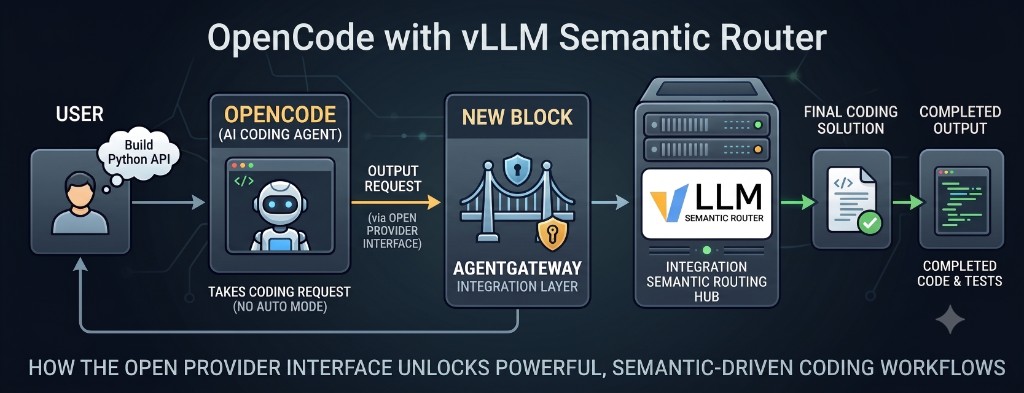
The Feature Everyone Wants and Almost Nobody Has
Cursor's Auto mode is deceptively simple: the developer types, and the IDE chooses whether a prompt deserves a frontier model or something faster and cheaper. It is easy to stop noticing — until moving to an open tool where every request starts with a model dropdown.
That gap matters more than it sounds. Teams everywhere are standing up local and internal model serving — a fine-tuned coder on owned GPUs, a frontier API for hard problems, a fast cheap model for everything else. The models exist. The serving works. What is often missing is the decision layer: something that reads each request and sends it to the right backend automatically.
OpenCode ships without a built-in Auto mode, but it does expose an open provider interface — enough to bolt intelligent routing on behind a single OpenAI-compatible endpoint.
This guide walks through building Auto mode for OpenCode (or any OpenAI-compatible client) with vLLM Semantic Router and AgentGateway: one endpoint, one model name, and an ML router choosing among the fleet per request. The configs below are complete; the failure modes are the ones that typically surface first in production setups.
[Demo video: three prompts from one OpenCode session, routed live to three different models]
First, Know Your Options: The Routing Algorithms in vLLM Semantic Router
"Auto mode" means different things to different teams. vLLM Semantic Router ships more than a dozen selection algorithms, each answering a different operational question:
| Algorithm | What it optimizes | Reach for it when... |
|---|---|---|
router_dc | Prompt ↔ model-description similarity (dual-contrastive embeddings) | Models are specialists — a coder, a reasoner, a generalist — and the prompt's intent should decide. The closest analogue to Cursor's Auto. |
multi_factor | Weighted quality / latency / cost / load score with SLO filters | Models are interchangeable (same capability, different deployments) and the goal is balancing budget and latency guardrails across a fleet. |
latency_aware | Live TTFT/TPOT percentiles | Hard latency SLAs apply — user-facing chat where p95 time-to-first-token is the metric that pages on-call. |
automix | Cost, via cascade + self-verification (POMDP, from the AutoMix paper) | Maximum savings with tolerated escalation: try the cheap model, verify its answer, escalate only on low confidence. Strong fit for batch/offline work. |
elo | Feedback-driven ranking | User feedback (thumbs, regenerations) should continuously improve rankings in production. |
knn / svm / mlp / kmeans | Learned routing from labeled examples | Historical data exists for "this prompt type → this model worked" and a trained policy is preferred over hand-written rules. |
rl_driven | Long-run reward | A reward signal is defined and the router should optimize it over time. |
hybrid | Intent + operational signals combined | Large fleets with both specialists and replicas, where "what is this prompt" and "which deployment is healthy" both matter. |
static | Determinism | Compliance and predictability: category X always routes to model Y, auditable, no surprises. |
Decisions can also be gated by signal rules — classifiers for intent, PII, and jailbreak detection. "Anything containing PII stays on the on-prem model" is enforceable as routing policy, not just documentation. When the primary need is governance rather than optimization, signal rules are the right layer.
Practical rule of thumb: interchangeable replicas → multi_factor or latency_aware. Specialist pools (local coder + frontier API) → prompt-aware routing with router_dc. The rest of this guide uses router_dc.
The Design: One Virtual Model Called MoM
The Semantic Router's core abstraction is a decision: a named bundle of candidate models, a selection algorithm, and a virtual model name the client calls. A typical Auto-mode setup exposes MoM — Mixture of Models:
decisions:
  - name: MoM
    description: "Mixture of Models router"
    priority: 100
    rules:
      operator: AND        # empty AND = catch-all (see gotcha #1 below!)
    modelRefs:
      - model: qwen-coder
      - model: gpt-4o
      - model: gemini-flash
    algorithm:
      type: router_dc
With router_dc, routing rules about prompt keywords are unnecessary. Instead, configure plain-English descriptions of what each model is good at:
modelCards:
  - name: qwen-coder
    description: >
      Specialized coding model optimized for programming tasks.
      Excellent at writing code, debugging, algorithms, ...

  - name: gpt-4o
    description: >
      Frontier reasoning model with exceptional analytical capability.
      Best for complex multi-step reasoning, strategic analysis, ...

  - name: gemini-flash
    description: >
      Fast general-purpose model. Ideal for simple factual questions,
      quick lookups, summarization, casual conversation, ...
At request time, an embedded mmBERT model (CPU, ~130MB) embeds the incoming prompt and compares it to those descriptions by cosine similarity. Example routing logs:
[RouterDC]   qwen-coder:   similarity=0.9998   ← "Write me a Python function..."
[RouterDC]   gpt-4o:       similarity=1.0000   ← "Compare utilitarian and deontological ethics..."
[RouterDC]   gemini-flash: similarity=0.9939   ← "What is the capital of Japan?"
Routing decision cost is typically 1–18ms on CPU. The descriptions are the routing policy — adding a fourth model (a SQL specialist, a legal model) is a new model card, not new application code.
Why this pattern qualifies as true Auto mode:
- The client stays simple. OpenCode holds no routing logic and no upstream API keys. Swap models, retune descriptions, add candidates — the client config stays fixed.
- Cost control is structural. In a coding agent, code-shaped traffic lands on the $0 local model; only prompts that genuinely need frontier reasoning incur frontier pricing.
- It fails soft. With gateway policy
failureMode: failOpen, a dead router process lets traffic fall through to a default route. Users see answers, not hard outages.
The Architecture
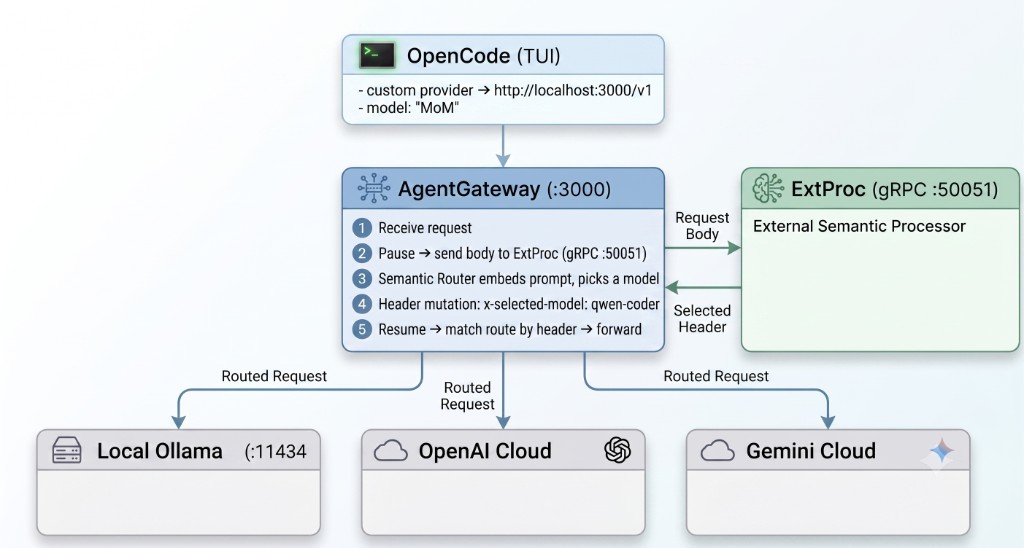
The Semantic Router runs as an Envoy ExtProc sidecar to AgentGateway — no extra proxy hop. The gateway pauses each request, streams the body to the router over gRPC, receives a header mutation, and resumes. Routes match on that header:
binds:
- port: 3000
  listeners:
  - routes:
    - matches:
      - headers:
        - name: x-selected-model
          value:
            exact: qwen-coder
      backends:
      - ai:
          provider:
            openAI: {}
          name: ollama
          hostOverride: localhost:11434
    # ... gpt-4o → OpenAI (with backendAuth),
    #     gemini-flash → Gemini (with backendAuth),
    #     plus a failOpen fallback route
A critical security split: the router never holds API keys. It classifies and sets a header; AgentGateway owns backendAuth and injects credentials per upstream. The component making ML decisions on untrusted input should hold zero secrets — especially when the endpoint serves a team rather than a single laptop.
Wiring OpenCode: The Whole Integration Is One Config Block
OpenCode accepts any OpenAI-compatible endpoint as a custom provider. In ~/.config/opencode/opencode.jsonc:
{
  "provider": {
    "auto_sr": {
      "name": "Auto (Semantic Router)",
      "npm": "@ai-sdk/openai-compatible",
      "options": {
        "baseURL": "http://localhost:3000/v1"
      },
      "models": {
        "MoM": {
          "name": "MoM",
          "limit": { "context": 32768, "output": 8192 }
        }
      }
    }
  }
}
The Semantic Router intercepts /v1/models and advertises the virtual model, so OpenCode's discovery finds MoM as if it were a real backend. Select the provider, pick MoM, and every prompt is classified server-side before it reaches an upstream LLM.
For observability, AgentGateway ships a built-in UI (build with --features ui, served at :15000/ui) and can persist every request to SQLite with cost attribution:
config:
  modelCatalog:
  - file: base-costs.json
  database:
    url: sqlite://agentgateway.db
Enable request persistence early — it pays off the first time routing behavior needs debugging.
Common Pitfalls
Four issues show up repeatedly when wiring this stack. Each applies broadly beyond OpenCode.
Pitfall 1: The catch-all rule that matches nothing
Older examples use rules: {} as "match everything." On current main, an empty rules block evaluates as an OR over zero conditions — which matches nothing. Requests silently fall back to the default model: no errors, plausible answers, zero actual routing. The tell in logs is "decision":"".
The documented catch-all is an empty AND:
rules:
  operator: AND
If the router "works" but never routes, verify the decision matches at all before tuning the algorithm.
Pitfall 2: Choosing an algorithm that ignores the prompt
multi_factor scores configured quality, pricing, and live latency signals. It is a fleet-balancing algorithm; the prompt never enters the equation. Without quality or pricing data configured, every factor is neutral and traffic sticks on the first candidate indefinitely.
For specialist pools (coder + reasoner + generalist), use router_dc. Reserve multi_factor for interchangeable replicas where cost, latency, and load are the primary tradeoffs.
Pitfall 3: A virtual model inherits its weakest backend's limits
A typical first failure after routing to a cloud model:
max_tokens is too large: 32000. This model supports at most 16384
completion tokens, whereas you provided 32000.
OpenCode cannot see individual backends behind MoM, so it may request a generous token budget. The virtual model's advertised limits must be the intersection across all candidates — smallest context window, safest output ceiling:
"limit": { "context": 32768, "output": 8192 }
The same intersection rule applies to tool calling, vision, and every other capability flag. Configure for the least capable backend, not the average one.
Pitfall 4: Agentic clients + small local models = malformed tool JSON
OpenCode is an agent: every request carries a large system prompt and a tool catalog (write, edit, webfetch, ...). Frontier models return structured tool calls. Smaller local models often emit a broken imitation as plain text:
> what is python language

{"name":"write","arguments":{"content":"Python is a high-level,
interpreted programming language...","filePath":"python_language.md"}}
OpenCode replays history on every request, so malformed JSON from earlier turns becomes part of the context and the session self-reinforces the wrong format. Teams running compact local models alongside agentic clients should expect some variant of this behavior.
Diagnosis requires payload capture. AgentGateway can log the full messages array:
frontendPolicies:
  http:
    accessLog:
      database:
        add:
          gen_ai.prompt: llm.prompt
          gen_ai.completion: 'llm.completion.map(c, {"role":"assistant", "content": c})'
A single SQL query against the access log reveals the exact prompt the model received — agent preamble, poisoned history, and all. Debugging LLM pipelines without payload capture is guesswork.
Mitigation: define a custom OpenCode agent whose prompt replaces the built-in agentic system prompt:
"agent": {
  "chat": {
    "description": "Plain chat through the semantic router",
    "mode": "primary",
    "model": "auto_sr/MoM",
    "prompt": "You are a helpful assistant. Answer directly and concisely in clean markdown. Use fenced code blocks for any code. Never output JSON tool calls.",
    "permission": { "edit": "deny", "bash": "deny", "webfetch": "deny" }
  }
}
Also set "tool_call": false on the model entry. Switch to the chat agent in the OpenCode TUI (Tab), start a fresh session (poisoned history does not self-heal), and models in the pool respond in clean markdown. Keep the default build agent for full agentic work with backends that handle tool calls reliably.
Expected Results
Three prompts, one OpenCode session, one provider, one model name:
| Prompt | Auto-routed to | Where it ran | Cost |
|---|---|---|---|
| "Write me a Python function to compute fibonacci numbers using memoization" | qwen2.5-coder | Local Ollama | $0 |
| "Compare utilitarian and deontological ethics for AI decision making..." | gpt-4o | OpenAI | ~$0.03 |
| "What is the capital of Japan?" | gemini-2.5-flash | ~$0.001 |
Routing overhead stays in the 1–18ms range on CPU. The gateway UI surfaces per-hop tokens and cost; the SQLite log retains the payload trail for post-incident review.
The outcome that matters: no model dropdown, no accidental frontier spend on trivial prompts, and no routing logic in the client — only English model descriptions and an embedding model that routes on semantic fit.
Takeaways
- Auto mode is a gateway feature, not a client feature. Build it once behind an OpenAI-compatible endpoint and every compatible tool inherits it.
- Match the algorithm to the business need. Specialist models →
router_dc. Interchangeable replicas →multi_factor/latency_aware. Maximum savings with escalation →automix. Governance → signal rules (PII, jailbreak). - A virtual model inherits the weakest backend's limits. Context, output, tool calling — intersection, not average.
- Payload logging is non-negotiable. Silent misroutes and poisoned agent sessions are invisible without the actual bytes on the wire.
- Keep keys out of the router. The component reading untrusted prompts should hold zero secrets; let the gateway own auth.
Teams standing up internal model serving and wanting Cursor-style Auto mode can get there with two YAML files and a JSON block, using AgentGateway and vLLM Semantic Router.
Get Started
- Install with agentgateway — Kubernetes integration guide
- Router DC selection algorithm — prompt-to-model-description routing
- Giving AgentGateway a Semantic Brain — homelab walkthrough with ExtProc routing
- Ollama local setup — run local models behind the gateway
Published for issue #2424. Have a community story about Semantic Router? Open a blog issue and the team will help get it published.